RSECon26, the UK conference for research software engineering, was held in Sheffield in September 2026. This provided a great opportunity for BioFAIR to engage with the Research Software Engineering community as one of the groups most interested and actively engaged in FAIR data practices. On Day 2, the BioFAIR team ran a workshop titled Reuse or Rebuild in the AI Era. The premise was simple – AI coding tools are making it dramatically easier to build something new from scratch. So, why bother reusing what already exists?
We put that question to a room of 50 research software professionals via a live poll, followed by a panel discussion, and found that the answers were more nuanced – and more reassuring – than the framing suggested.
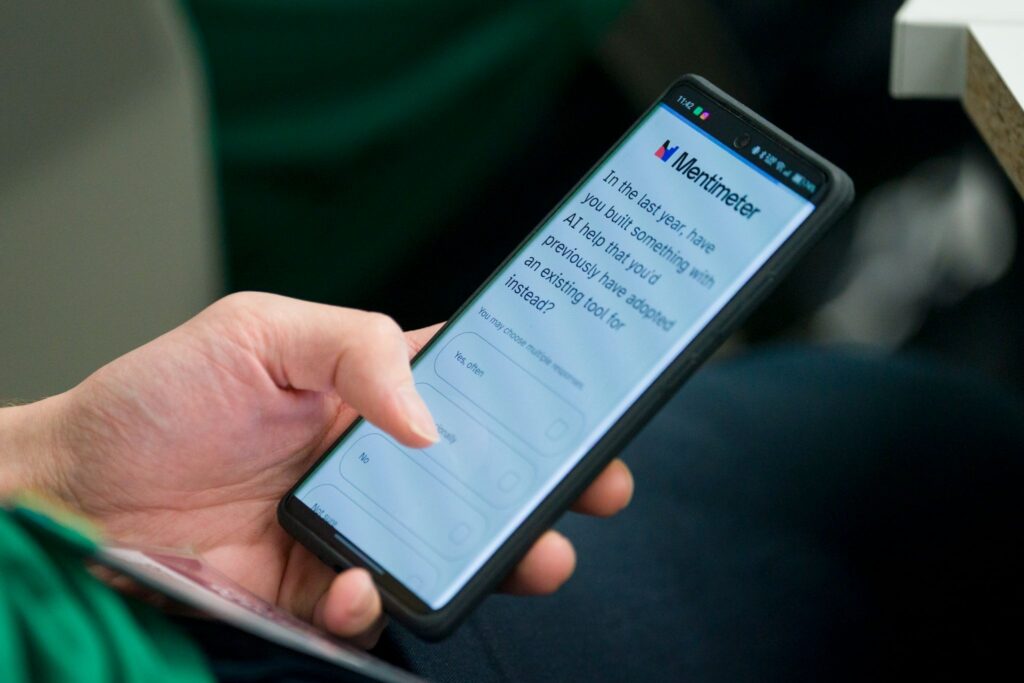
Our audience was overwhelmingly hands-on: Research Software Engineers made up the largest group, followed by leadership roles and researchers working mostly across life sciences and computer science. Most participants work with local HPC or university-level research infrastructure day to day, thus representing an important user group BioFAIR is aimed at serving. So what did we learn?
AI use has nearly doubled in two years
Today, 89% of the workshop respondents use AI in their work. Two years ago, that figure was 47%. That’s not a niche trend anymore – it’s close to universal. But how research software professionals use it tells a more measured story than “AI is replacing software engineering.” The poll showed that 50% of AI use is around coding: writing code (26%), implementing DevOps (14%) or doing data analysis (10%). The other 50% of AI use falls largely into idea generation and documentation.
Moreover, when asked about the opportunities created by AI, the majority of the audience (79%) noted that AI increased productivity, efficiency and automation of routine tasks, but only 7% said it helped achieve higher quality research outcomes. This showed AI more as an assistant embedded in existing knowledge and workflows – not, for most people, an autonomous system rebuilding the whole software stack.
So, are people actually rebuilding instead of reusing?
Asked directly whether they’d built something with AI help that they’d previously have reused an existing tool for instead, half of the room (49%) said “no“, 38% said “yes” and 13% were unsure.
Where rebuild-over-reuse does happen, it’s concentrated at the low-stakes end: small utility scripts (73%) and data wrangling (40%), not whole applications (24%) or full analysis pipelines (20%). AI, it seems, is lowering the bar for quick, disposable, personal tooling – not displacing the shared infrastructure the community depends on.
What are the real barriers to reuse
Here’s the finding that reframes the conversation: when we asked what actually stops people reusing existing software and tools, the top answer – by a clear margin, at 68% – was poor documentation. Trust in the quality or maintenance of existing tools (54%) and simple discoverability (50%) came next. “It’s just faster to ask AI” came in behind all three, at 40%.
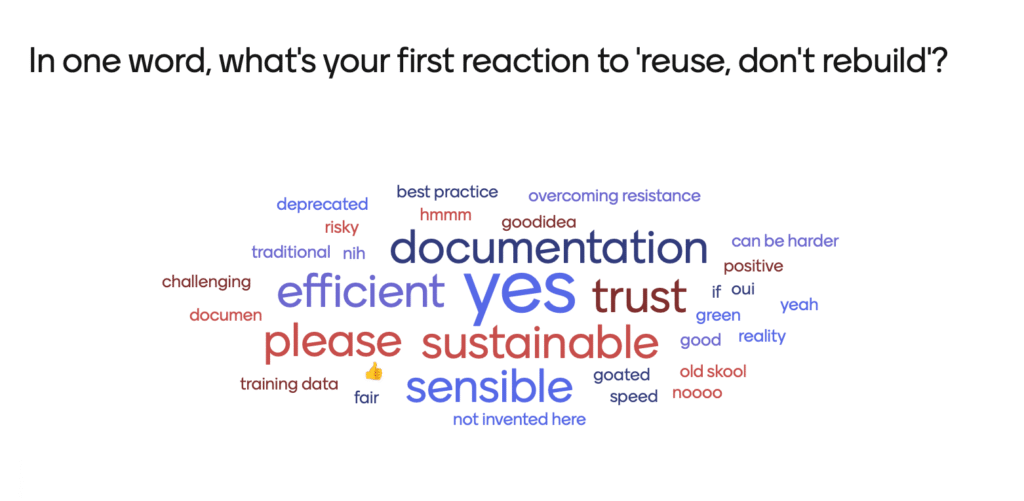
When we asked for a one-word gut reaction to “reuse, don’t rebuild,” the word cloud captured the room’s position: “yes,” “sustainable,” “trust,” “sensible” – and then some doubts alongside like “documentation,” “risky,” “can be harder.” The audience generally agreed reuse is the right value. However, not everyone finds it easy to live up to.
Concerns and benefits of AI, and what the panel made of them
The top-ranked concern about AI in the poll results was security, quality and ethics – ahead of environmental impact and the sense that AI erodes the creative parts of the job. Another theme that came up was trust in the AI outputs and need for review.
On the positive side, people valued how quickly AI gets you started, and some felt rebuilding beats wrestling with poorly designed code:
“AI is great for getting started, but outputs need lots of refining”
“Rebuilding is better than trying to use badly designed code.”
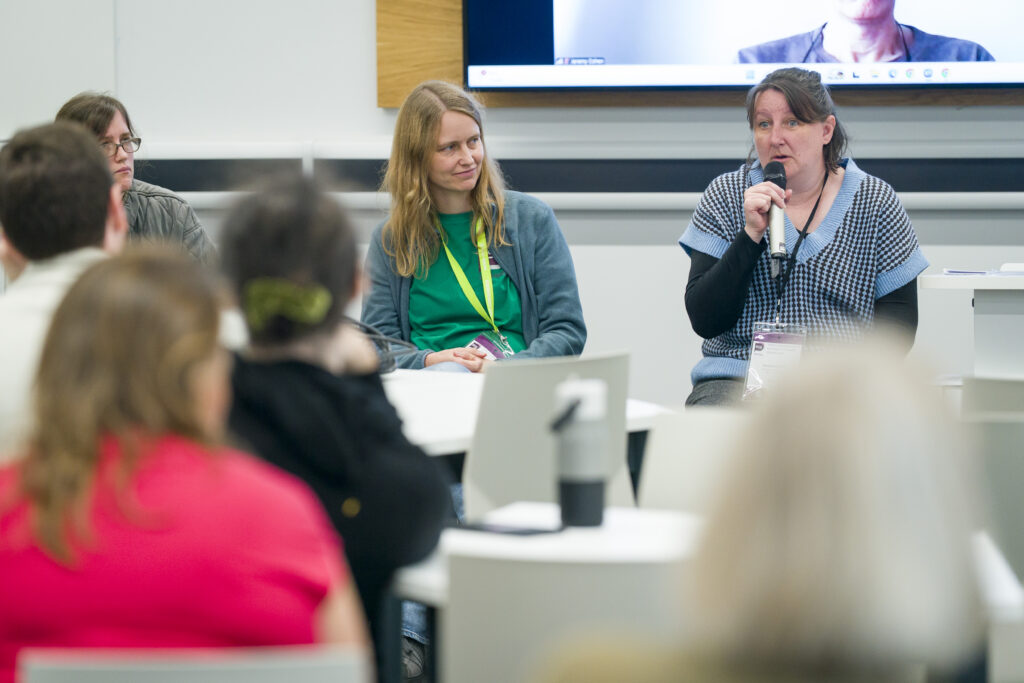
To dive into the themes the room raised, we were joined by an RSE community panel spanning climate science, life sciences, RSE strategy and policy:
- Dr Marion Weinzierl – Principal Research Software Engineer, Institute of Computing for Climate Science (ICCS), University of Cambridge
- Dr Mark Basham – Scientific Director for AI, The Rosalind Franklin Institute
- Samantha Ahern – Senior Professional Research Investment and Strategy Manager, Centre for Advanced Research Computing, UCL
- Dr Kamilla Kopec-Harding – Senior Research Data Scientist and Manager, Institute for Data Science and AI, University of Birmingham
- Dr Jeremy Cohen – Advanced Research Fellow in the Department of Computing and Director of RSE Strategy, Imperial College London
The discussion that followed delved deeper into the use of AI in scientific work and the impact of this shift, building on the concerns that were raised in the room earlier via the polls.
Some of the main topics discussed were:
1. Quality, under pressure to go fast. The concern from the panel wasn’t AI-generated code itself, but what happens to quality when speed and lower development cost become the primary driver. When results are “completely driven by speed and lower cost,” one panellist argued, quality is precisely where we need to tread carefully and you spend more time reviewing, not less.
2. Mindful use of AI. The room’s second-ranked worry was environmental impact, and the panel gave it a practical framing rather than a blanket objection: think about whether a given problem is actually worth solving with AI. It’s a brilliant tool for meaningful work, but running a model to generate a throwaway result doesn’t justify the cost.
3. Software supply chain trust . Most software is built partly from code that other people wrote and shared publicly, and that borrowed code often depends on still more code. This chain is sometimes referred to as the software “supply chain.” Earlier in the workshop, 68% of the room cited poor documentation and 54% cited trust (in quality or maintenance) as their top barriers to reuse. The panel discussed the impact of AI on the software supply chain. Trust, which was so hard-won in the first place, is now scarcer. Rebuilding with AI carries risks into the software supply chain: generated code can quietly pull in newly-created, unvetted dependencies, some of which may be actively harmful. The panel’s advice wasn’t to abandon package ecosystems altogether but to lean on well-maintained codebases and apply scrutiny.
- 4. Attribution and being FAIR. This was the thread the panel returned to most. When code is AI-generated, how do you comply with FAIR and FAIR4RS principles that depend on linking software back to the research objects and prior work it builds on? It’s not a small technical footnote – it’s a live, structural problem: LLM providers generally won’t disclose what training data or code shaped a given output, so attribution has effectively become, as one panellist put it, “part of the prompt” rather than a public, checkable record. The panel was clear that proper attribution (like a citation in a journal or a credited GitHub contribution) is what builds trust in the first place.
There’s also a harder tension underneath. Some worried that being transparent about AI use – documenting it, for instance – could itself work against researchers if funders read “I used GenAI for this” as a potential mark against a grant application.
5. Are we deskilling junior developers? This was the panel’s hardest, least resolved question. The friction of writing code from scratch is also how early-career researchers build foundational skill and curiosity. The panel’s worry wasn’t today’s junior developers, who still remember and understand that friction in learning from first principles – it is the cohort after them, who may skip it entirely by defaulting straight to an LLM without grappling with any underlying questions. The panel believed that the way forward wasn’t to withhold AI from new starters, but to be deliberate about leaving some of the “lower-hanging fruit” for them to solve by hand as a training mechanism.
6. Cost and privilege. This tied directly back to the audience’s own concern about AI’s “astronomical” cost, which several respondents flagged as prohibitive for under-resourced groups. The panel framed it as a widening gap rather than a static one: not everyone has the resources to use frontier LLMs, and the pressure to deliver fast can make that gap worse, not better – a task that might take a well-resourced, experienced engineer a couple of hours with the latest model could take a junior, or a team without that budget, a month.
Where does that leave us: Reuse, rebuilt for the AI era
If there’s one takeaway from the whole session, it’s that the “reuse vs rebuild” framing slightly overstates the conflict, and it seems it’s all about trust.
Research software engineers aren’t abandoning reuse because AI makes rebuilding easy – they are still supporting reuse, and the barriers that stop them are largely the same ones that predate AI entirely: undocumented code, uncertain trust, and hard-to-discover tools.
At the same time, AI itself makes it cheap to skip the step where trust is normally earned – the documentation, the rigorous review, the attribution, the active questioning and learning. Rebuilding isn’t the problem. Rebuilding instead of doing that work is.
Which points to where reuse and AI actually belong together, not in competition. Used and trained well, AI can summarise and surface existing tools before anyone writes a new one, generate the documentation that makes tools and knowledge trustworthy, and flag a dependency’s maintenance history before it’s pulled into a build. It becomes increasingly important, therefore, for developers of tools and databases to make certain that their work is discoverable by AI systems. Proper attribution to research objects and code and thoughtful consideration for the human elements in the system are also part of the solution.
The reuse-first instinct the room already has doesn’t need to compete with AI adoption – it needs to shape it. BioFAIR’s role can be to help make the existing landscape of data and software findable, accessible and trustworthy enough that reaching for it is still the fastest option, AI or no AI. Reuse doesn’t survive the AI era by resisting it; it survives by being built into it.
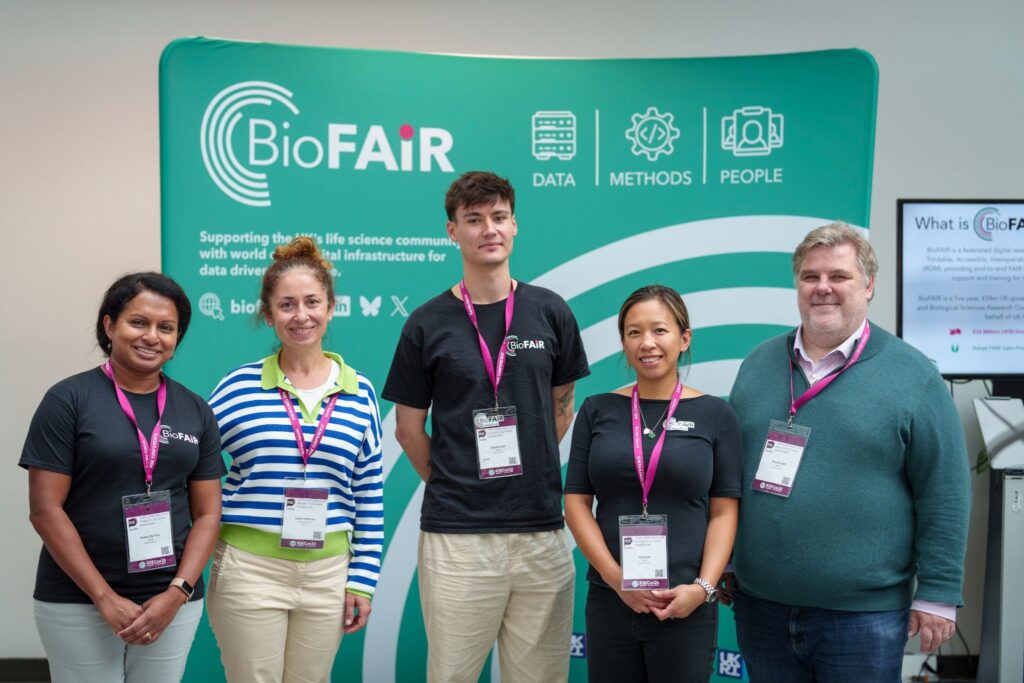
All photos courtesy Society of Research Software Engineering/Dominic Lipinski, CC BY NC dominiclipinski.com